

Our Story
How Dr. Frank Shapiro’s Personal Mission Became a National Legacy
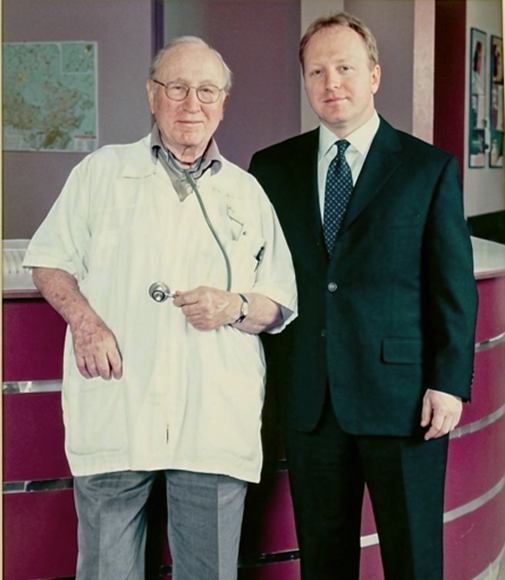
Lessons in Resilience
Born in 1920, Dr. Frank Shapiro grew up in Hamilton’s north end during the Great Depression—a time that taught him the value of hard work, resilience, and community. At just 11 years old, in 1931, his life changed forever when he was struck by a car and spent nearly a year in hospital.
He underwent multiple skin grafts and carried the scars and chronic pain for the rest of his life, but he also carried the lessons that experience taught him: perseverance, gratitude, and the understanding that recovery isn’t just physical, it’s human. Those months in hospital were his first real experience with consistent medical care and proper nutrition. They shaped his belief that good care could restore both dignity and independence, a belief that would define his view of medicine, rehabilitation, and return to work for decades to come.

The experience also gave him resolve. Determined to rise above hardship, Frank threw himself into learning and work. As a boy, he found creative ways to help support his family, collecting and reselling the wooden baskets used to sell apples and peaches, earning extra money to help his family and pay for his education. That early resourcefulness became the foundation of both his character and his entrepreneurial spirit, inspiring a drive to build, improve, and make things better for others.
From One Doctor to a Community Practice
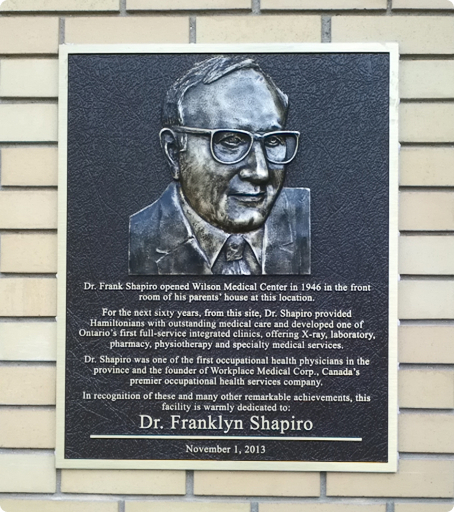
After medical school, Frank returned to Hamilton in the city’s industrial north end. Living there with his family, he soon found neighbours knocking on the door asking for medical help, and his family home became his first clinic and the current location of Workplace Medical Corp occupational health clinic and head office.
This was before OHIP, and families in Hamilton’s working-class neighbourhoods often couldn’t afford to pay for a doctor’s visit. Frank understood that reality and never let it harden him. When local physicians proposed raising their fee from $2 to $3, he opposed the plan, saying, “I can’t collect the $2, I’ll never be able to collect $3.”
Whether you twisted your ankle on the kitchen floor or the shop floor, my job is the same: to get you back to your regular duties as quickly as possible.
Dr. Frank Shapiro
Seeing Opportunity in Compassion
As his family practice grew, Frank began noticing a pattern. Many of his patients were employees of Hamilton’s industrial north end, steelworkers, machinists, and tradespeople who often came to him for doctor’s notes or medical excuses for time off.
While always compassionate toward workers, Frank also understood the pressures employers faced when absences piled up. He saw that large organizations like Stelco and Dofasco, each with tens of thousands of employees and entire occupational health departments staffed by physicians, nurses, and technicians, had the tools to manage these challenges. Smaller companies didn’t.
That insight became his turning point. He recognized an opportunity to bring the same level of occupational health expertise to small and mid-sized businesses, helping them care for employees and manage absences more effectively.
Using the entrepreneurial skills of his youth, he approached employers in the area to make them aware that they too could have access to the same type of occupational health care that Stelco and Dofasco were providing.
He had a practical, common sense approach to supporting the employer and the employee.
As he would say whether someone twisted an ankle on the shop floor or the kitchen floor, his goal was always the same — to help them return to their regular duties.
Pioneering Return-to-Work Medicine
Frank recognized the importance of early and safe return to work long before it was widely accepted. At the time, the standard medical advice for a sore back or workplace injury was to stay in bed, but he knew that movement, purpose, and connection to work were critical to recovery. Frank pioneered return-to-work programs that emphasized timely, active rehabilitation, introducing innovative practices like the Time Loss Review to get early objective medical support by talking to the employee’s family physician and collaboratively developing return to work plans. His blend of clinical skill, compassion, and common sense built lasting relationships throughout Hamilton’s working community.
Building the Foundation
As his reputation grew, so did the clinic. Frank gradually took over the entire house and, in the early 1980s, added an east-wing expansion to meet rising demand. By the mid-1990s, he had completed a 12,000 sqft. west-wing addition, transforming the modest family home into what would become the foundation of today’s 20,000 sqft. Wilson Medical Centre, now the company’s national headquarters.

Office opening 1951

WMC staff with “new” mobile hearing truck, circa 1978
Let’s Talk
Looking for a tailored strategy that supports your goals and your people? We’re ready to help — whenever you are.